

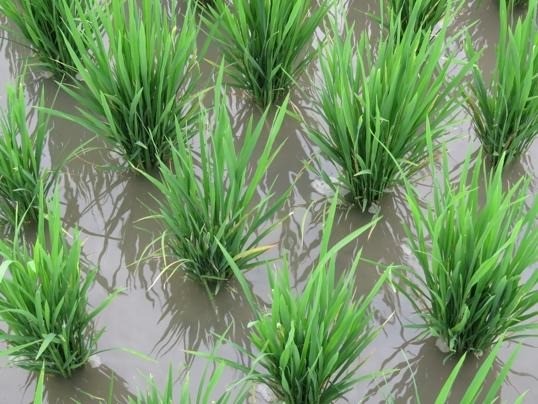
Standing on the edge of a rice paddy in Jiwan village, I’m watching as the water slowly moves down the slight slope, from one rice field into the next. There is no clear boundary where one farmer’s land ends and another’s begins. Bunds separate one paddy from the other connected only by channels that carry water, nutrients, and whatever else happens to be applied upstream. As someone from Australia, agriculture looks very different here in Indonesia. Back home, grain or cotton farms can stretch across thousands of hectares, clearly divided by fencelines that mark ownership with a simple, unspoken message: this is my land, and that is yours. Watching smallholder farmers here work side by side, with no fencelines – sharing labour, tools and water – it becomes clear that in a landscape like this, farming is not an individual act, but a collective one, sustained as much by cooperation as by the land itself.
As the week unfolds, this interconnectedness keeps resurfacing. I begin to see how sustainability, decision-making, and responsibility are shared across farming communities. Water is distributed from the same source, pests move freely, and practices such as fertiliser use or irrigation management ripple across entire communities. Therefore, issues like methane emissions, soil degradation, and declining water quality cannot be solved in isolation.
Working this week gave me a clearer view of how NGOs operate on the ground to support sustainable and resilient rice production systems. Rather than imposing solutions, KRKP works alongside farming communities to strengthen collective decision-making about how rice can be produced sustainably. Through its involvement in the Sustainable Rice Platform (SRP) and the Rice Resilience Project, KRKP helps translate global sustainability goals—particularly SDG 2 (Zero Hunger), SDG 13 (Climate Action), and SDG 12 (Responsible Consumption and Production) (United Nations, n.d.) —into practices that are workable at the local level, from improved water management to reduced reliance on chemical fertilisers and pesticides. KRKP’s focus extends beyond environmental outcomes to include farmer autonomy, fairer value chains, and long-term food sovereignty within Indonesia’s smallholder rice sector (KRKP, 2019).
Emissions – Climate Change Meets Rice Production
Walking out into the fields and talking with IPB student and researcher Adinda, I begin to truly comprehend the link between climate change and rice farming for the first time. Adinda points out the bubbles forming at the base of the flooded field and suddenly I see them everywhere. What I’d previously learned in a classroom becomes immediate and tangible. Under these continuously flooded conditions, oxygen is largely absent from the soil, creating an anaerobic environment where methanogenic microorganisms break down organic matter and produce methane as a by-product. This methane accumulates beneath the water and is released into the atmosphere and is up to 86 times more potent in terms of global warming potential when compared to CO2 in a 20-year term (Climate and Clean Air Coalition, n.d.).
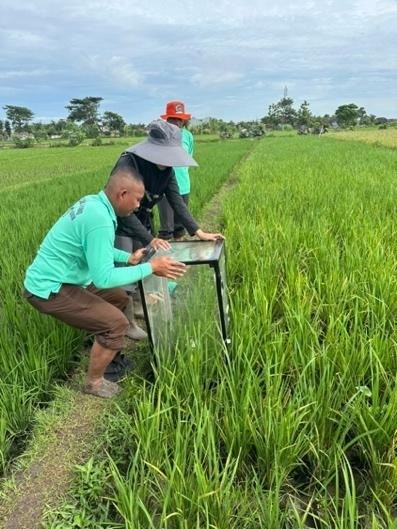
Rice is Indonesia’s most important staple crop, cultivated across millions of hectares and producing tens of millions of tonnes each year (Ansari et. al, 2023). This scale makes one reality unavoidable: rice production cannot simply be reduced or replaced. Under President Prabowo Subianto, the push for rice self-sufficiency has been reaffirmed, reinforcing the idea that Indonesia must continue to produce large volumes of rice even as climate pressures intensify. The challenge, then, is not whether rice should be grown, but how can it be produced more sustainably, and how its climate impact be reduced in line with SDG 13 on Climate Action.
To answer this question, Adin, Pak Anton introduce me to one possible solution which can make a big impact. The Alternate Wetting and Drying (AWD) irrigation method as a practical pathway toward lowering methane emissions and improving water use efficiency without greatly compromising food security. Rather than keeping paddies continuously flooded, AWD involves allowing the field to drain at specific stages of the rice growth cycle, reintroducing oxygen into the soil. This shift disrupts the anaerobic conditions required for methane-producing microorganisms to thrive, thereby substantially lowering methane emissions (Asch et. al, 2023). Adin explains that her research is already showing a strong link between AWD and reduced methane emissions compared with traditionally flooded paddies. Similar findings have been reported across the scientific literature. For example, field trials in the Vietnamese Mekong Delta report methane reductions of 60% and water savings of nearly 40% with only a small average yield reduction of ~8% across tested varieties, highlighting AWD’s strong potential as a climate-smart irrigation strategy (Asch et al., 2023).
While AWD appears technically straightforward, its implementation is far more complex within Indonesia’s smallholder landscape. Since agriculture here consists of millions of smallholder farmers who operate on fields of as small as 0.5 hectares or less (Ansari et. al, 2023), changing long-established farming practices presents a significant challenge. Irrigation in Indonesia dates back thousands of years and is deeply embedded in culture. Traditional beliefs are centred around the idea that rice fields must be continuously kept flooded even though this is not agronomically necessary (Tirtalistyani et. al, 2022).
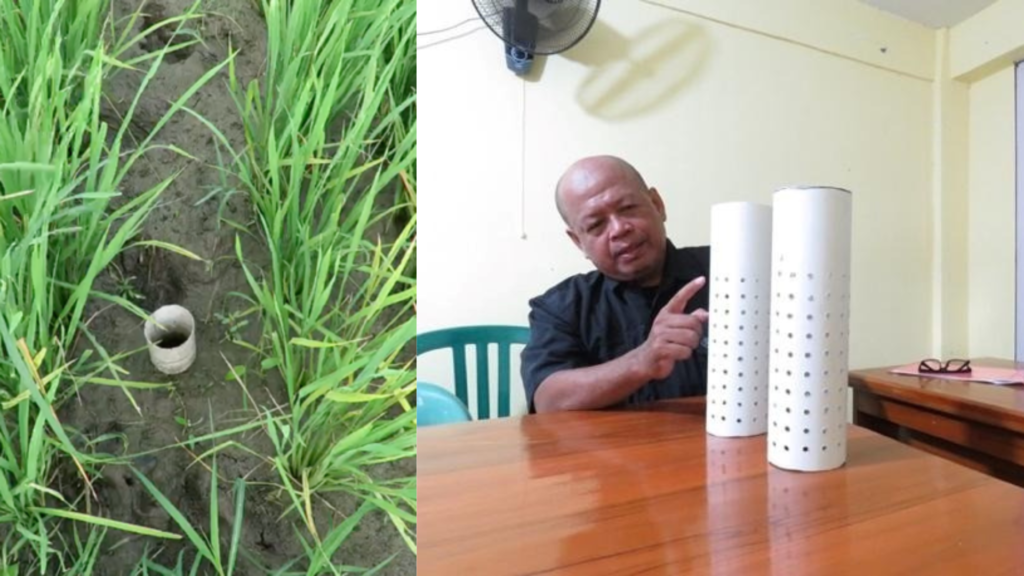
On top of such beliefs, irrigation systems are shared, informal, and highly interdependent. One farmer cannot adopt AWD independently if neighbouring fields remain flooded, as water levels must be coordinated across entire blocks of paddies. This highlights how climate solutions in smallholder systems depend less on individual willingness and more on collective organisation and trust.
Organic vs Inorganic Inputs
Building on the interconnected nature of smallholder rice farming, decisions around fertiliser and pesticide use also extend well beyond individual paddies. Nutrients and chemicals applied in one field can be exported through surface runoff, entering shared irrigation canals and flowing into downstream paddies (Cui et. al 2020). In gravity-fed irrigation systems, which are common across Indonesia, these effects are amplified. Chemical inputs do not remain confined to the plots where they are applied; instead, they circulate through entire farming landscapes. From a sustainability perspective, this creates cumulative environmental pressures, including declining soil health and deteriorating water quality, that cannot be addressed through isolated action.
In response to these challenges, reducing reliance on synthetic fertilisers and pesticides is often presented as a pathway toward more sustainable rice production. Such a shift aligns closely with SDG 12 on Responsible Consumption and Production. However, as with irrigation practices, the feasibility of this transition is deeply shaped by the realities of smallholder farming.
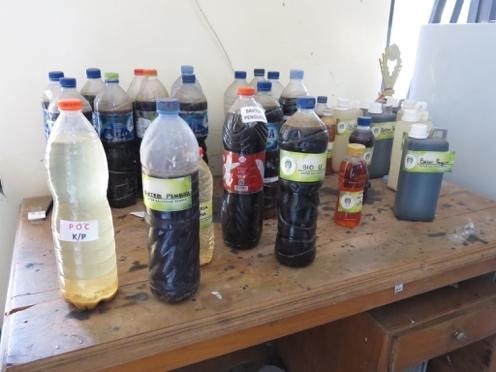
Visiting the organic farmers’ group IPOJI provided insight into how organic practices can be implemented collectively. At their headquarters, I learn about the use of locally produced inputs such as MOL (local microorganisms) to support decomposition and soil health, POC as a nutrient-rich fermented fertiliser, and ZPT to stimulate plant growth. These methods aim to improve soil quality, reduce chemical dependency, and strengthen long-term resilience. However, they are knowledge-intensive and require time, coordination, and shared commitment among farmers to be effective.
Scientific comparisons between organic and chemical systems highlight the complexity of this transition. In short-term trials, rice fertilised with synthetic inputs has been shown to outperform MOL-based organic systems, with average yields of approximately 5.5 tonnes per hectare compared to 4.2 tonnes per hectare under organic fertilisation (Lestari, 2022). While these results demonstrate a statistically significant yield gap in the short term, they are based on single-season observations and do not capture longer-term soil recovery or productivity gains.
This raises a critical question in the context of Indonesia’s national goal of rice self-sufficiency: can organic rice production meet the country’s food security demands? As Pak Joko from the IPOJI farmers’ group explains to me, “we haven’t yet reached the maximum harvest we hoped for. Our version of organic farming involves changing from a completely chemical farming habit. Converting to organic farming takes quite a long time.” His reflection underscores a key tension: while organic methods offer environmental promise, they require extended transition periods that may conflict with immediate production targets.
Conflicting Ideas
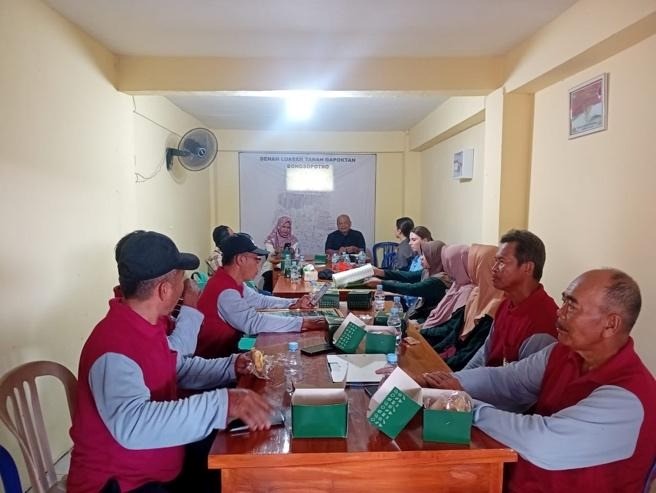
IPOJI weren’t the only farmers’ group we met on our journey. We travelled North-East to desa Bongosopotro where a farmers group meeting is being held. The topic for discussion is the Sustainable Rice Cultivation Module presented by the Ricesilience project supported by KRKP. The module covers a range of topics, including nutrition, water and pest management, as well as planting and harvesting techniques, with particular emphasis on alternate wetting and drying (AWD) irrigation, soil water monitoring, and organic alternatives to chemical inputs.
In contrast to the passionate organic-oriented farmers of IPOJI, Bongopostro farmers expressed a reluctance to adopt new methods particularly those involving organic inputs. They believe the process is too complicated and have a preference towards the convenience of synthetic fertilisers and pesticides, valuing their speed, simplicity, and reliability. This reluctance is rooted in structural challenges such as uneven land, dependence on groundwater for irrigation, and the constant threat of rat infestations, all of which make experimentation with new farming practices costly and uncertain.
These contrasting perspectives also raise questions about the feasibility of a rapid or complete transition to more sustainable rice production in Indonesia. While organic practices offer clear environmental benefits, they often require transition periods during which yields can fluctuate and labour demands increase. In a country where rice remains central to national food security, and where recent political priorities have reinforced the goal of rice self-sufficiency, such uncertainty carries real risk for smallholder farmers. For many, the immediate reliability of synthetic fertilisers offers a sense of security that organic alternatives have yet to match at scale.
This raises an important question about whether sustainability agendas risk placing disproportionate responsibility on smallholder farmers, without adequately addressing the structural and policy support required to make such transitions viable at scale.
Smallholders, Risk, and Constraint: Why Collective Action is Essential
Understanding why sustainability initiatives such as organic inputs and Alternate Wetting and Drying face resistance requires attention to the structural realities of smallholder farming in Indonesia. The country’s agricultural sector is made up of approximately 28 million farming entities, around half of which are smallholders operating on plots of 0.5 hectares or less. On landholdings of this scale, even minor disruptions to yield or timing can have immediate consequences for household income and food security.
This economic vulnerability shapes farmer decision-making. Practices that involve uncertainty – such as transitioning to organic fertilisers or altering irrigation regimes – are often perceived as high risk, particularly when benefits may only materialise over the long term. Labour demands further compound this challenge. Organic methods require additional preparation, monitoring, and knowledge, while AWD demands careful coordination and timing. For farmers already operating under time and labour constraints, these requirements can be prohibitive.
Dependence on neighbouring practices intensifies these risks. Pests, water flows, and chemical runoff move freely across field boundaries, meaning that individual efforts toward sustainability can be undermined if surrounding farmers do not adopt similar practices. As a result, both organic transitions and climate mitigation strategies like AWD are difficult to implement at the individual level. Resistance, therefore, reflects not a lack of awareness or willingness, but rational responses to structural constraints.
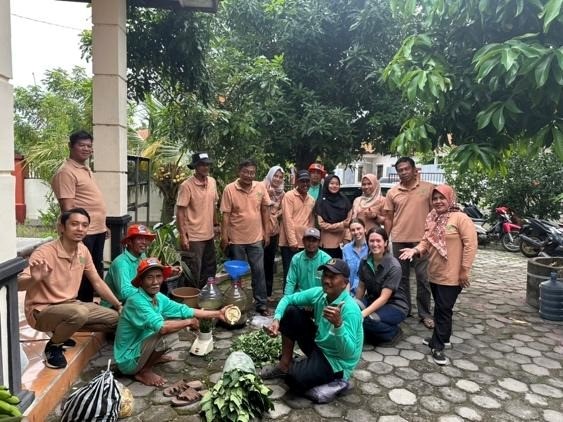
In this context, collective action becomes essential. Organisations such as KRKP play a critical role in facilitating coordination, reducing individual risk, and supporting group-based adoption of sustainable practices. By working at the community level and linking farmers to broader frameworks such as the Sustainable Rice Platform, these organisations help transform sustainability from an individual burden into a shared, more achievable process.
Mognild Eerkens – ACICIS intern at KRKP
References
Ansari, A., Pranesti, A., Telaumbanua, M., Alam, T., Taryono, Wulandari, R. A., Nugroho, B. D. A., & Supriyanta. (2023). Evaluating the effect of climate change on rice production in Indonesia using multimodelling approach. Heliyon, 9(9), Article e19639. https://doi.org/10.1016/j.heliyon.2023.e19639
Asch, F., Johnson, K., Vo, T. B. T., Sander, B. O., Duong, V. N., & Wassmann, R. (2023). Varietal effects on methane intensity of paddy fields under different irrigation management. Journal of Agronomy and Crop Science (1986), 209(6), 876–886. https://doi.org/10.1111/jac.12662
Climate and Clean Air Coalition. (n.d.). Methane — short-lived climate pollutants. CCAC. Retrieved [18 Dec. 25], from https://www.ccacoalition.org/short-lived-climate-pollutants/methane
Cui, N., Cai, M., Zhang, X., Abdelhafez, A. A., Zhou, L., Sun, H., Chen, G., Zou, G., & Zhou, S. (2020). Runoff loss of nitrogen and phosphorus from a rice paddy field in the east of China: Effects of long-term chemical N fertilizer and organic manure applications. Global Ecology and Conservation, 22, Article e01011. https://doi.org/10.1016/j.gecco.2020.e01011
Kedaulatan Pangan (KRKP). (2019). Vision and mission. KedaulatanPangan.org. Retrieved [18 Dec. 25], from https://kedaulatanpangan.org/vision-and-mission/
Lestari, B.L, (2024) Substitution of Chemical Fertilizer with Organic MOL Fertilizer to Increase Crop Productivity. Indonesian Journal of Agriculture and Environmental Analytics. https://doi.org/10.55927/ijaea.v3i2.10626
United Nations. (n.d.). Sustainable Development Goals. United Nations. Retrieved [18 Dec. 25], from https://sdgs.un.org/goals
Tirtalistyani, R., Murtiningrum, M., & Kanwar, R. S. (2022). Indonesia Rice Irrigation System: Time for Innovation. Sustainability, 14(19), 12477. https://doi.org/10.3390/su141912477
 Indonesian
 English