

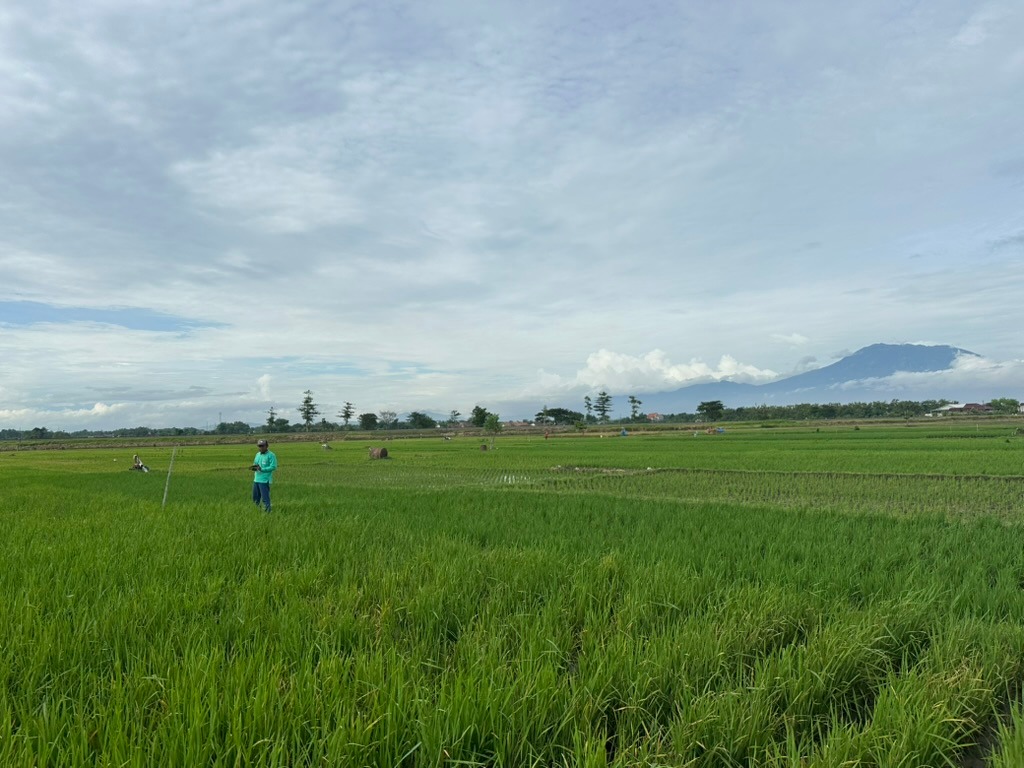
Rice is obviously a staple in Indonesian’s diet, I noticed this after spending a month in the city, suburbs, and rural java. “If there’s no rice we haven’t eaten” was a common phrase I often heard, a symbol of national identity. As the train carriage rocked gently, we traversed through endless fields of rice paddies separated briefly by terracotta roofed villages. I was definitely on my way to the rice district of java. The Madiun district supplied 37,458 tons of Dry Milled Grain in 2024 and will continue to increase its production in conjunction with the presidents’ ideas to make Indonesia a self-sufficient country (BPS-Statistics Indonesia Madiun regency, 2025).
Since taking office in 2024, Prabowo has placed food self-sufficiency at the center of his national vision, alongside independence in energy and water (Davidson, 2018). Rice self-sufficiency is framed not only as an economic goal, but as a matter of sovereignty and national pride. Yet my time in Madiun suggests that while this vision is achievable, it is far more complicated than increasing production figures on paper. It will be interesting to see how Indonesia will go about increasing rice production without undermining environmental sustainability, farmer livelihoods, and nutritional well-being.
By examining land expansion and management, mechanization, organic practices, and nutrition—through the lenses of the Sustainable Rice Platform (SRP) this article argues that rice self-sufficiency is possible, but only if national ambition aligns with local realities.
Land Expansion and the Challenge of Land Management
One strategy to boost rice production nationally is land expansion. Plans are underway to convert swamp land and open new rice fields in South Sumatra and Papua’s Merauke Regency (Mujahiddin., Nasution, N., et al., 2025). The goal for these projects is to rapidly increase the amount of cultivated land and therefore radically increase the output of rice within the nation, particularly in response to population growth and political pressure for self-sufficiency. There are many things to consider for this transformation, a big one being the impact it will have on ecosystems. Swamp lands generally hold a lot of carbon within the soil and cultivating this could lead to a large release of carbon and methane into the atmosphere. These risks highlight the tension between short-term production goals and long-term environmental stability.
During a drive to Bong Sopotro, I observed large buildings under construction on what had recently been fertile agricultural land. While Indonesia has laws that prohibit the conversion of designated “sustainable food agricultural land,” enforcement is often weak at local levels. Rapid urbanization, infrastructure development, and rising land values make it economically attractive for farmers to sell or lease their land for non-agricultural purposes. Given that an average farming household in Madiun may only own 0.5 hectares, the conversion of agricultural land represents not just a loss of production capacity, but the displacement of entire livelihoods and intergenerational farming knowledge (Prasada, I., Dhamira, A., et al., 2022).
From an SRP perspective, self-sufficiency should not depend solely on expanding cultivated land. It is important that emphasis is drawn on increasing productivity through better land and water management rather than continuous expansion. Similarly, KRKP advocates for land sovereignty, arguing that farmers must have secure access to land if they are expected to feed the nation. Without strong land protection and enforcement, Indonesia risks losing agricultural land as quickly as it creates new fields—undermining the very foundation of self-sufficiency.
Mechanization: Efficiency and Inequality
Mechanization is another cornerstone of Prabowo’s vision. As we stood in the paddy’s there was a quiet buzz of machinery in the distance signaling a shift away from traditional labor-intensive methods. Combine harvesters move swiftly across wet fields, leaving muddy tracks behind but harvesting up to ten times faster than manual labor. When combined with mechanical tillers, these technologies can significantly shorten production cycles and increase annual output.
From a national perspective, mechanization appears essential for improving efficiency and reducing post-harvest losses. The Sustainable Rice Platform (SRP) encourages such efficiency gains, provided they minimize resource waste and environmental harm. However, modernization also carries risks, particularly for rural employment and unequal access to opportunities.
KRKP addresses this tension by supporting initiatives that help smallholder farmers access technology without being marginalized. For example, partnerships between farmer groups and universities such as IPB (Institut Pertanian Bogor) provide weather stations, soil testing, and technical training. These efforts help ensure that small-holder farms will not fall behind in the race to modernization and the gap between large agribusinesses and small-scale farmers doesn’t widen. In contrast, some organic farmer groups continue to control pests manually; while this approach reduces reliance on pesticides, it is labor-intensive and significantly slower to implement.

On our first day, we visited a demonstration plot where university students Adin and Vina were researching how different irrigation methods affect greenhouse gas emissions from rice paddies. Their preliminary findings supported alternate wetting and drying as the most sustainable approach. This method involves inserting a perforated PVC pipe (figure 1) approximately 20 cm into the soil, with about 10 cm remaining above the surface. The paddy is then flooded until the water level reaches around 5 cm above the ground. Irrigation is repeated only when the water level inside the pipe falls to about 5 cm at the bottom. By allowing the soil to periodically dry, this method reduces methane formation and limits the release of methane bubbles into the atmosphere. Looking into the future, this could also be a way of preserving water resources in the face of climate change. Observing research like this highlighted the importance of involving young people in developing more modern, sustainable and resource-efficient farming practices.
Organic Practices and Long-Term Sustainability
During my time in Madiun, I spent several days with members of IPOJI, an organic rice farmers’ group. Their goal is to produce rice organically to improve soil health, reduce dependence on chemical inputs, and secure higher prices in the market, particularly as input costs continue to rise. Pak Joko explains the process when first converting an area of land to become organic. “At the beginning of planting, we start by improving the soil quality. Second, we introduce lots of beneficial microbes and fungi. Third, we gradually balance the use of organic fertilizers with chemical fertilizers so that the results remain consistent, while still aiming for an organic future.” Farmers spoke of the challenges they faced whilst switching from conventional to organic. “As for organic yields, we haven’t yet reached the maximum harvest we hoped for.” It was evident in the demonstration plots that the organic paddy was showing signs of yellowing leaves, a possible sign of nitrogen deficiency or as a result of this rice variety being harvested twice in a season.
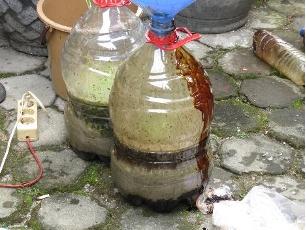
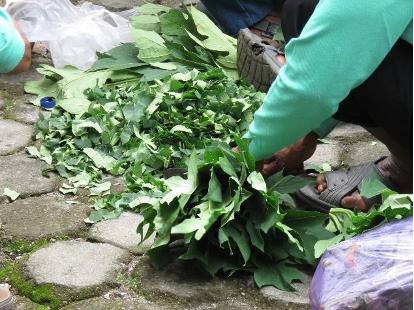
Despite this, IPOJI members were committed to their approach, optimistic of the improvements it was making to their soils over time. At their headquarters, farmers worked together to produce liquid fertilizer by blending snails collected from the paddies, papaya leaves, molasses, and fruit, as shown in figure 2 & 3. The process was communal, filled with conversation and shared learning. I noticed that in a space where high-level education is not common, farmer groups play a crucial role in sharing experiences and knowledge, making it easier to adopt sustainable practices collectively and share limited resources.
Other supplements IPOJI is creating include PGPR (plant growth–promoting rhizobacteria), Piperia, and Trichoderma for pest control. These handmade supplements aim to reduce the input costs of rice production as well as support other farmers, who can purchase them from IPOJI at a small price. This ensures farmers have the option to farm organically and helps them move away from reliance on government-subsidised fertilisers, which are tightly regulated, and limited to specific crops and land sizes.
By advocating for fair pricing mechanisms that reward sustainable practices, organic practices will not be left behind in the race for self-sufficiency but instead recognised as a long-term investment in resilience and soil health.
Processing, Supply Chains, and National Integration
Rice self-sufficiency can also extend beyond the field. At a rice mill in Bong Sopotro, I observed a vertically integrated process where rice was received from partner farmers, dried in the sun or in a drying bin, de-husked, polished, bagged, and distributed to customers across the region. With support from the Sustainable Rice Platform, this family-owned business has also transitioned away from diesel generators, reducing energy-related emissions and long-term operating costs. From a Sustainable Rice Platform (SRP) perspective, this kind of integration reflects best practice: minimizing post-harvest losses, improving resource efficiency, and strengthening traceability between farmers and processors. The UD Kayra Makmur rice mill demonstrated Indonesia’s ability to manage the entire production chain domestically at a commercial scale. Processing rice within Indonesia reduces dependence on external actors, supports local economies, and allows byproducts to be reused. Pak Yoyo explained that rice bran was sold to chicken farmers, while husks were repurposed as mulch and soil cover, aligning with SRP’s emphasis on circular resource use and waste reduction.
Nutrition and culture.
Rice sits at the heart of everyday life in Indonesia. It is present at every meal, woven into language, routines, and ideas of what it means to be properly fed across households and communities. While rice remains an essential source of calories, it is not nutritionally sufficient on its own. KRKP highlights that rice was not historically the primary staple across all regions of Indonesia, and that a growing dependence on white rice has contributed to dietary imbalances. White rice is low in fiber and key micronutrients such as calcium, magnesium, zinc, and iron, with iron deficiency remaining a particular concern among young women.
In response, nutritional supplements are widely marketed, and government initiatives such as the Makan Bergizi Gratis program aim to provide children, toddlers, pregnant women, and breastfeeding mothers with balanced meals (Setiabudi, T., Rahmawati, R., et al., 2025). These interventions can help in the short term, but they aren’t a replacement for eating a variety of whole foods regularly. Recent concerns regarding inconsistent nutritional standards and food safety incidents highlight the risks of relying too heavily on meal programs rather than strengthening everyday dietary diversity through local food systems (Setiabudi, T., Rahmawati, R., et al., 2025).
This makes me question whether Indonesia should prioritize rice self-sufficiency over nutrition. A more resilient vision of food security would value rice as one important component of the diet, while also protecting and promoting other local staples. It is important that organizations like KRKP continue to advocate for balanced diets and for the government to create policies that encourage the consumption of other local staples, especially among younger generations. Encouraging a more varied diet can improve health and contribute to a more resilient food system that values nutritional quality alongside food production.
Is Rice Self-Sufficiency Possible?
Can Indonesia achieve rice self-sufficiency under Prabowo’s vision? I believe it can, but not without confronting the realities on the ground. Experiences in Madiun reveal both promise and tension: fertile land, innovative farmers, and growing technological progress exist alongside ongoing land conversion, environmental stress, and persistent socio-economic challenges. For this vision to succeed, government policies must move beyond targets and slogans, translating into practical, long-term solutions that provide continuous and meaningful support for farmers. This includes ensuring land is managed sustainably, that mechanization and modernization are genuinely accessible to smallholders, that organic and regenerative practices receive ongoing backing, and that nutrition is recognized as a central component of food security. Organizations such as KRKP, alongside frameworks like the Sustainable Rice Platform (SRP), play a critical role in bridging policy and practice, helping to ensure that rice self-sufficiency becomes not merely a political ambition, but a lived and resilient reality in villages like Madiun and across Indonesia.
Ditulish Oleh:Phoebe Hewetson – ACICIS intern at KRKP 2025
References
BPS-Statistics Indonesia Madiun regency. (2025, April 8). Harvested area and rice production in Madiun regency 2024 (fixed figures). https://madiunkab.bps.go.id/en/pressrelease/2025/04/08/49/luas-panen-dan-produksi-padi-di-kabupaten-madiun-2024–angka-tetap-.html
Davidson, J. (2018). Then and Now: Campaigns to Achieve Rice Self-Sufficiency in Indonesia. Journal of the Humanities and Social Sciences of Southeast Asia, 174(2-3), 188-215. https://doi.org/10.1163/22134379-17402001
Mujahiddin., Nasution, N., Martinelli, I. (2025). Sufficiency Discourse in the Prabowo Era: A Study of the Inaugural and August 15, 2025 Speeches. PERSEPSI: Communication Journal, 8(2), 102-114. https:// doi.org/10.30596/persepsi.v8i2.27566
Prasada, I., Dhamira, A., & Dwi, A. (2022). Agricultural land availability and farmer’s income in Java Island, Indonesia, 1990–2018. Regional Statistics, 12(3), 85–103. https://doi.org/10.15196/RS120304
Setiabudi, T., Rahmawati, R., & Supriantino, T. (2025). Free Nutritious Meals Policy as a Stimulus for Strengthening the Economic of Farmers and Traditional Markets: A Literatur Review. Indonesian Journal of Social Science Research, 6(2), 641-652. https://doi.org/10.11594/ijssr.06.02.25
 Indonesian
 English